
151 Front Street West, Toronto
Half rack colocation. Room for the whole stack.
21U of private, lockable rack space at 151 Front Street West from $1,299 a month. 1Gbps unmetered, a /29 subnet and 24/7 unescorted access. Two hundred dollars a month less than two quarter racks.
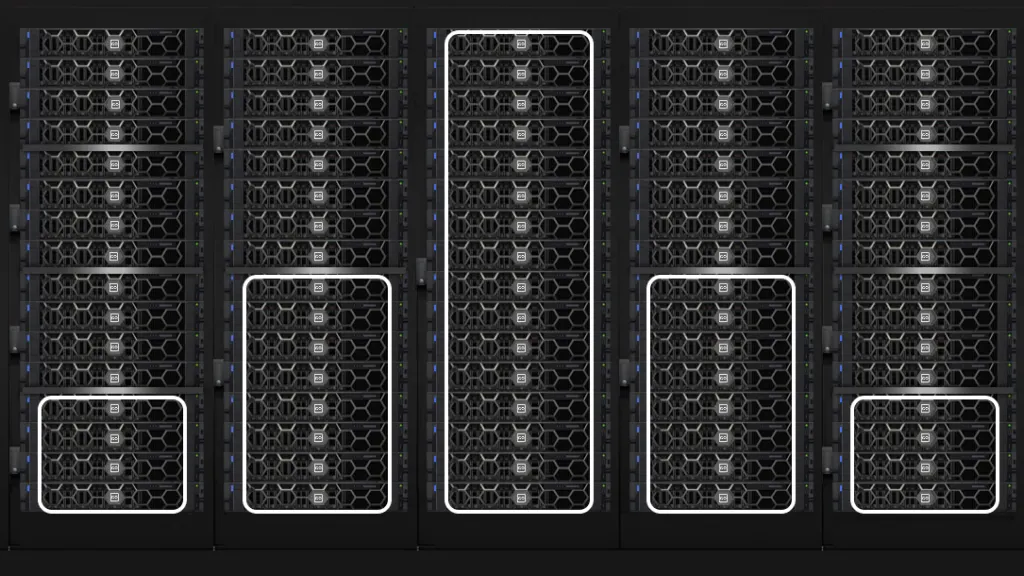
Lockable rack space
Per month, CAD
110V circuit included
Half rack explained
Twenty-one units in one locked enclosure.
A half rack is 21U inside a dedicated locked enclosure at 151 Front Street West containing only your equipment. Enough room for hosts, switching, firewalls and storage in a single cabinet, instead of splitting an estate across two smaller racks.
You get 24/7 unescorted access with a unique rack code known only to your authorised team.
21U lockable private enclosure, 24″ W x 42″ D x 36.75″ H.
20 amps at 110V. The same circuit as the quarter rack, which the power section below explains.
1Gbps unmetered uplink, /29 subnet with 5 usable IPv4 addresses. Up to a /24 available.
24/7 unescorted via card or Bluetooth, two access cards included.
99.99%.
The maths
One half rack beats two quarter racks.
Both prices are published on this site, so this is a comparison you can check rather than a sales claim.
20U split across two enclosures, on two 20 amp circuits.
21U in a single enclosure, on one 20 amp circuit.
One extra rack unit, one cabinet to cable instead of two.
The saving is real, and so is the trade-off: one circuit, not two. If power rather than space is your constraint, two quarter racks can genuinely win.
Power
The half rack ships the same circuit as the quarter rack.
A quarter rack includes 20 amps at 110V for 10U. A half rack includes 20 amps at 110V for 21U. The space roughly doubles and the included circuit does not, so watts per unit go down rather than up.
What is included
Loaded to 80 percent, giving roughly 1.7 kW of usable draw across the whole 21U. Fine for storage, network gear and moderately loaded hosts.
When two quarters win
Two quarter racks carry two circuits for 20U. If you are filling the rack with dense compute, that is more power for $199 a month more.
Additional circuits, higher-capacity circuits, 208V and three-phase are available. Ask before you populate the rack, not after. Above standard density, high density colocation runs to 15 kW per rack in TOR1 and 30 kW in TOR2.
Included with every half rack
What comes with the 21U.
1Gbps unmetered port
Dedicated to your hardware. No data caps, no overages. Upgradeable to 10Gbps or 100Gbps on request.
/29 subnet 5 usable IPs
A /29 IPv4 subnet included. Additional subnets and BYOIP with BGP available on request.
Always-on DDoS mitigation
Traffic monitored and filtered continuously. No configuration required. Active from day one.
24/7 unescorted access
Access your rack at any hour via physical card or Bluetooth (Verkada app). No scheduling. 2 complimentary cards included.
Cross-connects
In-suite and MMR cross-connects available. Direct access to 400+ networks at 151 Front Street West.
Facility TOR2
N+1 redundant power, UPS and generator. Enwave cooling. SOC 2 Type II, PIPEDA, PHIPA. 99.99% uptime SLA.
Capacity
What fits in 21U.
Keep the top and bottom units for patching and power distribution rather than compute. Filling 21U edge to edge makes every future change slower and riskier than it needs to be.
1. Six to eight hosts
2U servers, enough for a real virtualization cluster with failover capacity.
2. Redundant switching
A pair of top-of-rack switches rather than a single point of failure.
3. Firewall pair and storage
Active and passive firewalls plus a storage shelf, all in the same enclosure.
4. Two to three units spare
Patch panel, PDU, and room to add hardware without a redesign.
FAQ
Common questions about half rack colocation.
Sizing and price
Is one half rack better than two quarter racks?
On price and space, yes. Two quarter racks cost $1,498 a month for 20U. One half rack costs $1,299 for 21U, so you save $199 a month and gain a unit. On power, no: two quarter racks come with two 20 amp circuits and a half rack comes with one. Choose on whichever constraint binds first.
How many U should I leave for switching and cabling?
Plan on three to five units of the 21 for switching, firewalls, a patch panel and a PDU before you count compute. Leaving the top and bottom units for patching and power distribution keeps later changes simple.
When should I move from a quarter rack to a half rack?
When you are consistently above 8U, or when you are about to order a second quarter rack. At that point the half rack is cheaper, gives you a unit more space and puts everything in one enclosure.
Power and layout
Does a half rack include more power than a quarter rack?
No, and this is the most important thing to know about the tier. Both include 20 amps at 110V. The half rack gives you 21U rather than 10U on the same circuit, so power per unit is lower. Additional and higher-capacity circuits, 208V and three-phase are available, and should be specified before you populate the rack.
What happens if I need more than 20 amps?
Additional circuits are available, as are higher-capacity, 208V and three-phase options. If your requirement is genuinely dense, high density colocation is the better fit: TOR1 runs to 15 kW per rack and TOR2 to 30 kW per rack, with in-row cooling and hot and cold aisle containment.