
151 Front Street West, Toronto
High density colocation. Up to 25kW per rack.
TOR2 at 151 Front Street West is built for dense compute hardware. In-row cooling units, hot and cold aisle containment, and Enwave deep lake cooling handle the thermal load. 208V and three-phase power available. Bring your own hardware.
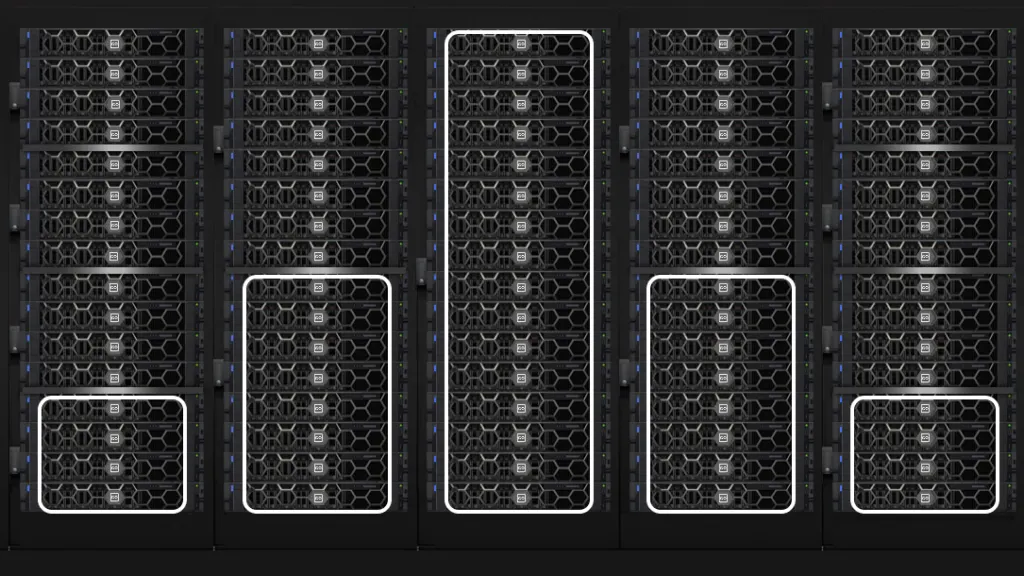
What is high density colocation
Standard racks are not designed for dense compute.
A standard colocation rack is designed for 2kW to 5kW of power draw. Modern GPU servers, AI inference nodes, and HPC hardware can draw 5kW to 25kW per rack. Without purpose-built cooling and power infrastructure, that hardware cannot run reliably at sustained load.
TOR2 at 151 Front Street West is built for this. In-row cooling units manage heat at the rack. Hot and cold aisle containment separates intake and exhaust airflows across the suite. Enwave deep lake water cooling provides the primary facility-level thermal capacity. Power circuits go to 25kW per rack with 110V, 208V, and three-phase options.
High density colocation at Amanah is a bring-your-own-hardware service. You own and manage your servers, GPUs, and networking equipment.
Standard colocation
High density TOR2
Power density range
Cooling infrastructure
Three layers of thermal management.
TOR2 addresses heat at the rack, the aisle, and the suite level ensuring reliable operation at sustained high density.
In-row cooling units
Dedicated cooling units positioned in the row alongside your racks. Heat is captured and removed at the source before it spreads into the surrounding airspace. Enables high power density without impacting adjacent racks.
Hot and cold aisle containment
TOR2 uses hot and cold aisle containment throughout. Cold supply air is delivered to server intake faces. Hot exhaust air is isolated and routed directly to return pathways. Eliminates hot spots and improves cooling efficiency across the entire suite.
Enwave deep lake cooling
The primary cooling system for 151 Front Street West draws cold water from Lake Ontario. Enwave's deep lake cooling provides exceptional thermal capacity and energy efficiency purpose-built for dense compute environments.
N+1 redundant cooling
All cooling systems in TOR2 are N+1 redundant. A full additional cooling unit is available at all times to maintain thermal management in the event of a primary system failure. Designed for continuous operation at full load.
Power options
Power configured to your hardware
specifications.
All circuits backed by UPS and generator with on-site fuel.
| Option | Voltage | Typical use | Availability |
|---|---|---|---|
|
Standard 20A single phase | 110V | Standard servers, networking, storage | Included |
|
Higher amperage Custom circuit | 110V | Dense 1U/2U servers, higher draw hardware | On request |
|
Higher voltage 208V single phase | 208V | GPU servers, AI nodes, high-performance hardware | On request |
|
Three-phase 3-phase distribution | 208V / custom | GPU clusters, HPC nodes, large PDUs | On request |
|
B power feed Secondary redundant | Matches primary | Dual-corded hardware requiring feed redundancy | On request |
|
Maximum per rack Up to 25kW | Custom | GPU and AI clusters at full density | Talk to sales |
Infrastructure included
Everything your hardware needs to
run.
colocation clients at 151 Front Street West.
Up to 100Gbps unmetered
TORIX and 400+ networks
Cloud on-ramps
Always-on DDoS mitigation
24/7 unescorted access
Remote Hands
Use cases
Any workload that needs serious
power density.
High density colocation supports hardware that exceeds standard rack power limits.
You bring the hardware. Amanah provides power, cooling, connectivity, and physical
security.
AI and ML
GPU and AI training
NVIDIA H100, A100, and other dense GPU servers for model training and inference. TOR2’s cooling and power handles the thermal and electrical load without throttling.
HPC
High-performance compute
Storage
High-density storage
Rendering
GPU rendering farms
Inference
AI inference endpoints
Research
University and research computing
Dense compute for genomics, climate modelling, and AI research. PIPEDA compliant, Ontario infrastructure satisfying Canadian data residency requirements.
FAQ
Common questions about high density colocation.
Basics
What is colocation?
Financial workloads require physical security, compliance documentation, and predictable latency to Canadian financial networks. Amanah’s SOC 2 Type II certification and PIPEDA compliance satisfy most financial services infrastructure audit requirements.
What is included with every plan?
Shared rack vs private rack?
Why 151 Front Street West?
Shared rack: your hardware is in an open rack alongside other clients, no physical separation, escorted access during business hours. Private rack: the entire enclosure is yours locked, dedicated with 24/7 unescorted access and access cards.