
151 Front Street West, Toronto
Full rack colocation. Forty-four units and two power feeds.
44U of private, lockable rack space at 151 Front Street West from $1,999 a month, with dual A and B power feeds, 1Gbps unmetered, a /29 subnet and 24/7 unescorted access.
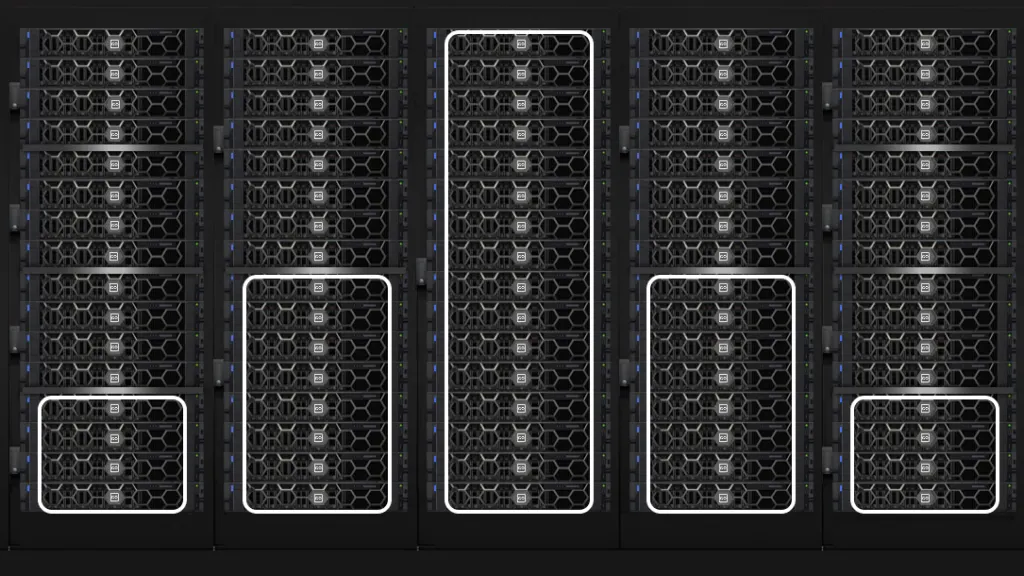
Lockable rack space
Per month, CAD
A and B power feeds
Full rack explained
A whole cabinet, and the only tier with two feeds.
A full rack is a complete 44U enclosure at 151 Front Street West containing only your equipment. It is the largest single-rack deployment Amanah sells before cages and suites, and the only tier that ships with two independent 20 amp power feeds.
You get 24/7 unescorted access with a unique rack code known only to your authorised team.
44U lockable private enclosure, 24″ W x 42″ D x 77″ H.
2 x 20 amps at 110V, independent A and B feeds. No other tier includes two.
1Gbps unmetered uplink, /29 subnet with 5 usable IPv4 addresses. Up to a /24 available.
24/7 unescorted via card or Bluetooth, two access cards included.
15 kW per rack in TOR1, 30 kW in TOR2.
Redundancy
A and B feeds change the risk profile.
Every other tier runs on a single circuit. A full rack runs on two, fed independently. Dual-corded hardware takes one cord from each, so losing a feed to a breaker, a PDU fault or planned maintenance does not take the hardware down.
Feed A and feed B
Two independent supplies at 110V, included as standard on this tier and no other. Most enterprise servers, switches and storage arrays are dual-corded and take one cord from each.
Size for one feed
Each feed should carry the entire load on its own. Budget around 1.7 kW of usable draw, not 3.4 kW. Load both feeds to capacity and losing one takes the rack down.
Single-corded hardware goes behind an automatic transfer switch, or it is the single point of failure inside an otherwise redundant rack. Both are legitimate choices. It should be a decision rather than an oversight.
Migration
Moving a server room into one rack.
A full rack is usually where an on-premise estate lands. The hard part is rarely the hardware, it is the planning. Remote hands racks and cables on arrival, from $100 an hour.
1. Inventory
Every device with its rack units, power draw and network ports. This document is what sizes the circuits.
2. Rack elevation
Decide what sits where before anything ships. Patching at the top, power at the bottom, compute in between.
3. Cutover order
Which services move first, what depends on what, and how long each window needs to be.
4. Rollback
For anything business critical, what you do if the cutover fails. Decide it before the truck arrives.
Included with every full rack
What comes with the 44U.
1Gbps unmetered port
Dedicated to your hardware. No data caps, no overages. Upgradeable to 10Gbps or 100Gbps on request.
/29 subnet 5 usable IPs
A /29 IPv4 subnet included. Additional subnets and BYOIP with BGP available on request.
Always-on DDoS mitigation
Traffic monitored and filtered continuously. No configuration required. Active from day one.
24/7 unescorted access
Access your rack at any hour via physical card or Bluetooth (Verkada app). No scheduling. 2 complimentary cards included.
Cross-connects
In-suite and MMR cross-connects available. Direct access to 400+ networks at 151 Front Street West.
Facility TOR2
N+1 redundant power, UPS and generator. Enwave cooling. SOC 2 Type II, PIPEDA, PHIPA. 99.99% uptime SLA.
Sizing
When a full rack is not enough.
44U is one cabinet. If the constraint is power rather than space, more racks are the wrong answer and high density is the right one.
44U, 2 x 20 amps A and B, one locked enclosure. You are here.
Additional private racks in TOR2, with first right of refusal on adjacent space and inter-rack cross-connects.
One fenced boundary around all your racks, for separation between client environments.
For power rather than space. 15 kW per rack in TOR1, 30 kW in TOR2.
FAQ
Common questions about full rack colocation.
Power and redundancy
What are A and B power feeds, and do I need both?
Two independent 20 amp circuits supplying the same rack. Dual-corded hardware takes one cord from each, so losing a feed to a breaker, a PDU fault or planned maintenance does not take the hardware down. You need both if uptime during a power event matters to you, and the full rack is the only Amanah tier that includes them as standard.
Does two feeds mean twice the power budget?
No, and treating it that way removes the redundancy. Size each feed so it can carry the entire load on its own, which means budgeting around 1.7 kW of usable draw rather than 3.4 kW. If you load both feeds to capacity, losing one takes the rack down.
What do I do with single-corded hardware?
Put it behind an automatic transfer switch so it can draw from either feed, or accept that it is the single point of failure inside an otherwise redundant rack. Both are legitimate choices, but it should be a decision rather than an oversight.
Sizing and migration
Is one full rack cheaper than two half racks?
Yes. Two half racks cost $2,598 a month for 42U. One full rack costs $1,999 for 44U, so you save $599 a month, gain two units, and get the A and B feeds that neither half rack includes.
How much of a 44U rack should I actually fill?
Plan on filling 34 to 38 units. Reserve the top for patching, the bottom for power distribution, and leave several units spare for growth and airflow. A rack filled edge to edge on day one makes every later change harder and constrains cooling.