

Part of our “Inside 151 Front” series – a technical look at the infrastructure behind Toronto’s most interconnected data center.
Cross-connects at 151 Front Street West in Toronto play a critical role in enabling carrier-neutral, scalable colocation deployments. This building is widely regarded as one of Canada’s primary interconnection hubs and home to the Toronto Internet Exchange (TorIX).
Multiple carriers operate within this space, creating a dense network ecosystem. However, carrier presence alone does not create connectivity; it creates potential.
That potential becomes reality through cross-connects.
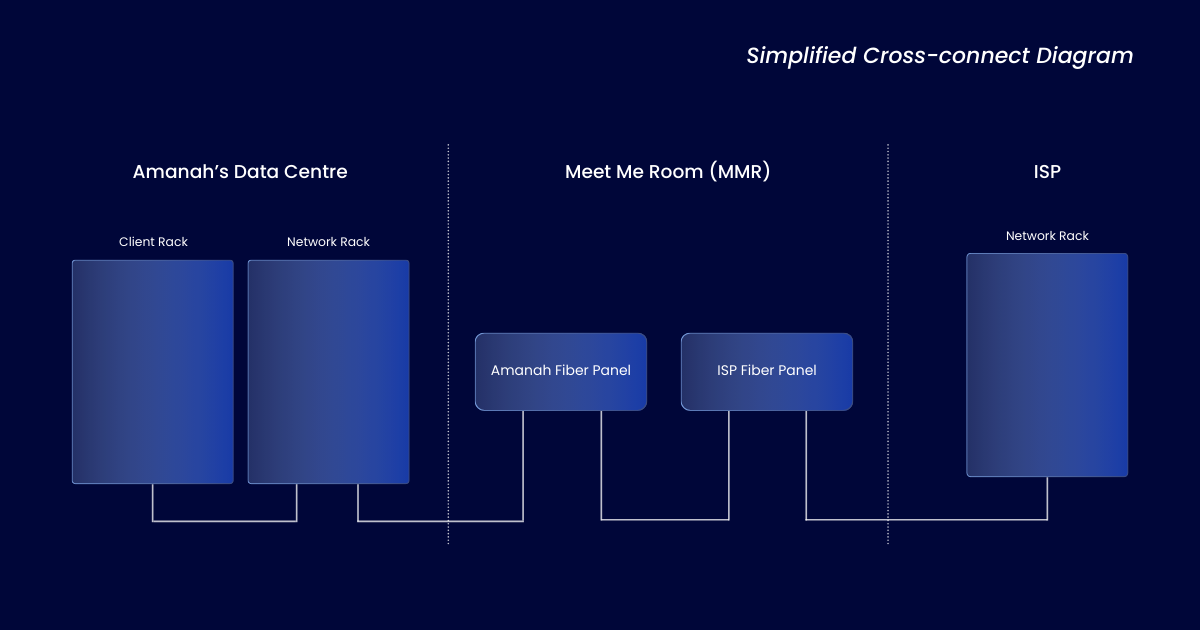
A cross-connect is a dedicated physical connection installed inside the data center that connects a customer cabinet to a carrier’s termination point in the Meet-Me Room (MMR) – the centralized interconnection space within the building.
As an infrastructure provider operating within Canada’s most carrier-dense facility, Amanah designs cross-connect architecture to support long-term network control and cost predictability.
This article explains how cross-connect architecture with Amanah Tech at 151 Front enables flexible, scalable, and affordable colocation.
From Carrier Density to Controlled Network Design
Carrier density within 151 Front provides access to multiple transit and backbone networks inside a single facility. Cross-connect architecture determines which of those networks terminate directly in your cabinet and how traffic exits your infrastructure.
When a cross-connect is provisioned, a dedicated fiber path is established between your cabinet and a selected carrier’s panel in the Meet-Me Room (MMR).
The router connects via an optical interface and establishes a session with the provider. This direct termination places upstream connectivity under your routing policies, rather than behind a shared aggregation layer.
Because routing policies are enforced locally at the router, operators can control how traffic leaves the network using attributes such as local preference, AS path prepending, or MED values.
As carriers are already present inside the building, connectivity can be provisioned without external fiber builds.
This reduces deployment complexity and supports predictable scaling as requirements evolve.
💡 At Amanah’s colocation space, cross-connect provisioning is coordinated with cabinet layout, port density, and projected growth to ensure carrier access integrates cleanly into your deployed infrastructure from day one.
Redundancy Implemented Through Physical Interconnection
Redundancy inside a carrier-neutral facility is implemented through structured cross-connect diversity.
Provisioning a single cross-connect to one upstream provider creates dependency. Provisioning multiple cross-connects to diverse providers enables multi-homing.
In a multi-homed configuration, BGP (Border Gateway Protocol) automatically shifts traffic between providers during upstream failure events.
When a provider experiences packet loss, latency spikes, or a full upstream outage, BGP reconvergence allows traffic to shift to an alternate provider based on routing policy and path availability.
As providers terminate directly in the cabinet through dedicated cross-connects, failover occurs at the routing layer without requiring manual intervention.
For example, provisioning two cross-connects to diverse Tier 1 transit providers allows automatic failover using BGP during upstream disruption.
As multiple carriers are present within 151 Front, redundancy can be implemented within the same building, avoiding the additional cost and complexity that come with separate external facilities.
💡 Within Amanah deployments, failover paths and carrier diversity are designed intentionally, with defined failover paths and provider diversity built into the colocation deployment.
Routing Authority and Provider Control
Routing authority is influenced by where carriers terminate.
When multiple providers terminate directly in a cabinet through dedicated cross-connects, routing decisions remain internal to the deployed infrastructure.
Traffic engineering, outbound policy, and provider preference are enforced at the router level rather than constrained by a single upstream path.
This structure enables balanced upstream utilization and preserves provider flexibility. Operators can shift traffic toward preferred upstream providers for cost optimization, performance improvements, or geographic routing preferences.
When only one provider terminates locally, upstream path diversity becomes constrained and routing decisions depend on that provider’s external network policies.
💡 At Amanah, cross-connect architecture supports direct multi-provider termination, preserving routing control within the deployed environment.
Scalability and Long-Term Flexibility
Scalability in a carrier-dense facility differs from a limited-carrier environment.
In facilities with limited carrier presence, scaling may require external fiber builds, extended provisioning timelines, or reliance on a single provider’s upgrade path – introducing delay and additional costs.
At 151 Front, multiple transit and transport providers are already present inside the building.
Adding a new upstream relationship usually involves provisioning an additional cross-connect rather than constructing new external fiber, making expansion both faster and more affordable.
Where capacity exists, bandwidth can be increased by upgrading optical interfaces or activating higher-capacity ports without relocating cabinets.
💡 Within Amanah’s environment at 151 Front, cross-connect and cabinet planning are aligned to support affordable incremental growth without infrastructure redesign.
Conclusion
At 151 Front Street West, carrier density creates opportunity – but cross-connect architecture determines how that opportunity is realized.
When carrier termination is structured intentionally, redundancy follows defined paths, routing authority stays internal, and scaling happens through additional cross-connects rather than external builds.
This is what makes colocation more flexible, scalable, and affordable over time at Amanah.
Explore Amanah’s colocation pricing to see how structured cross-connect architecture can support your deployment at 151 Front.
Our Most Common Questions About Cross-connects
- What is a cross-connect at 151 Front Toronto? A cross-connect at 151 Front Street West is a dedicated fiber connection that links a customer cabinet to a network provider inside the building’s Meet-Me Room (MMR). It enables direct access to transit, transport, and private network services available within the facility.
- Why is 151 Front Street West important for network connectivity? 151 Front Street West is one of Canada’s primary interconnection hubs. The building hosts a large concentration of network carriers and is home to the Toronto Internet Exchange (TorIX). This carrier density allows colocation customers to establish direct cross-connects to multiple providers within the same facility.
- How does a cross-connect differ from Internet transit? A cross-connect is the physical fiber link inside the data center that connects your cabinet to a provider. Internet transit is the carrier service that delivers access to the public Internet. The cross-connect enables access to that service.
- Why are multiple cross-connects used in carrier-neutral colocation? Multiple cross-connects are used to connect directly to separate upstream providers. This enables BGP multi-homing, allowing traffic to automatically reroute during upstream carrier failures and reducing single-provider dependency.
- Does carrier neutrality automatically provide redundancy? No. Carrier neutrality means multiple providers are available in the facility. Redundancy only exists when cross-connects are provisioned to diverse carriers and routing policies are structured for failover.
- How does 151 Front support scalable connectivity? Because 151 Front Street West is carrier-dense, additional providers can be activated by provisioning new cross-connects rather than building external fiber. Bandwidth can often be increased by upgrading ports or optical interfaces inside the building.
- How does Amanah integrate cross-connect planning into colocation deployments? At Amanah’s colocation facility within 151 Front, cross-connect planning is aligned with cabinet layout, port density, and redundancy objectives from the start. This supports structured multi-provider architecture and scalable infrastructure growth.
- Is 151 Front carrier-neutral? Yes. 151 Front Street West is a carrier-neutral facility with multiple transit and transport providers present inside the building. Cross-connects enable direct access to those providers.
- What is the Meet-Me Room (MMR) in a data center? A Meet-Me Room (MMR) is the centralized interconnection space inside a data center where network carriers terminate their infrastructure. Cross-connects are installed between a customer cabinet and a carrier’s panel in the MMR to establish direct connectivity.
- What are the benefits of cross-connects in a carrier-neutral data center? Cross-connects provide direct, private connectivity between a customer cabinet and network providers inside the facility. This allows organizations to reduce latency, implement multi-provider redundancy, control routing policies, and scale network capacity without external fiber builds.
- How long does it take to provision a cross-connect at 151 Front? Provisioning timelines depend on carrier availability and facility procedures. In carrier-dense facilities like 151 Front Street West, cross-connect installation is typically faster than external fiber builds because the providers already maintain infrastructure inside the building. At Amanah Tech, cross-connect provisioning typically takes about one (1) week.