

TORONTO—The pendulum of server infrastructure preferences swings predictably for SaaS. Five years ago, the conversation centered entirely on cloud migration. Today, we’re witnessing a nuanced return to dedicated infrastructure, particularly among mature SaaS providers. This is an evolution in knowing when and where different infrastructure models deliver optimal value.
Key Takeaways:
- Dedicated servers for SaaS restore predictability. You remove multi-tenant noise, set real baselines, and troubleshoot faster.
- Total cost of ownership improves when engineering stops chasing phantom infra issues and focuses on product.
- Location is a performance feature. Hosting near major internet exchanges cuts latency and jitter for regional users.
- Compliance is simpler with full control of network, keys, data residency, and audit evidence.
- Hybrid wins in practice. Keep core app and data on dedicated; use cloud for CDN, dev/test, DR, and burst.
- Plan for the inflection. Around 10k–50k active users, revisit cost, latency, and compliance, then migrate deliberately.
- Think evolution, not either/or. Re-evaluate workload placement as features, traffic patterns, and regions change.
What is a SaaS Infrastructure?
Every successful SaaS platform follows a remarkably similar infrastructure journey. Early-stage companies start with shared hosting or basic cloud instances; the focus is on rapid deployment and minimal operational overhead. This makes perfect sense when you’re validating product-market fit and every dollar counts.
However, somewhere between 10,000 and 50,000 active users, the calculus changes. Performance inconsistencies that were minor annoyances become customer retention issues. Compliance requirements that seemed distant become immediate necessities. The “unlimited” cloud scaling that looked attractive on paper reveals its true cost structure.
Types of SaaS Servers
In a modern SaaS setup, many of these are managed through cloud platforms (AWS, Azure, GCP) instead of physical servers, but the server roles remain the same.
| Server Type | Role / Function | Examples |
| Application Servers | Run the SaaS app logic, APIs, and workflows. | Node.js, Django, Spring Boot |
| Web Servers | Handle HTTP/HTTPS requests, serve frontend assets, route to app servers. | Nginx, Apache, Caddy |
| Database Servers | Store and manage structured/unstructured data. | MySQL, PostgreSQL, MongoDB, Cassandra |
| File/Storage Servers | Store static files like docs, images, and media uploads. | Amazon S3, Google Cloud Storage |
| Authentication Servers | Manage users, logins, tokens, and identity federation. | Auth0, Keycloak, Okta |
| Cache Servers | Temporarily store frequently accessed data to boost performance. | Redis, Memcached |
| Search Servers | Provide full-text search, filtering, and analytics capabilities. | Elasticsearch, Solr, OpenSearch |
| Load Balancers | Distribute traffic across servers for scalability and fault tolerance. | HAProxy, AWS ELB, Nginx |
| Analytics/Logging Servers | Collect logs, monitor performance, and generate insights. | ELK Stack, Prometheus, Grafana |
| Mail/Notification Servers | Handle transactional emails, alerts, and push notifications. | Postfix, SendGrid, Amazon SES, FCM |
Cost of Infrastructure for Dedicated SaaS Servers
When evaluating infrastructure options, most organizations focus on the visible costs: server rental, bandwidth, storage. The hidden costs, however, often dwarf these line items.
Consider engineering time. In shared or heavily abstracted environments, debugging performance issues becomes exponentially more complex. When a query that typically executes in 50 milliseconds suddenly takes 500 milliseconds, is it your code, the database configuration, noisy neighbors on the shared infrastructure, or network congestion? Each possibility requires different expertise and investigation methods.
With dedicated servers, you eliminate variables. Performance characteristics become predictable. Your team can establish legitimate baselines and quickly identify actual issues rather than chasing shadows in shared infrastructure.
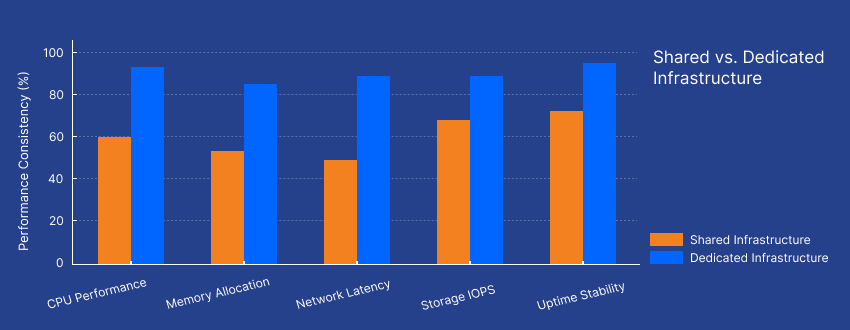
Geographic Considerations Often Overlooked
The physical location of servers matters more than many organizations realize. Proximity to major internet exchanges can reduce latency by 60-80% for regional users. For SaaS platforms serving specific geographic markets, this difference translates directly to user experience and retention.
Toronto, for example, hosts TorIX, one of the world’s largest internet exchanges. SaaS providers serving Canadian financial services from servers located at this exchange point see sub-millisecond latency to Bay Street trading floors. The same application hosted in a generic cloud region might experience 20-30ms latency, negligible for some use cases, but critical for others.
Security and Compliance for SaaS Servers
Dedicated servers provide regulatory control. You determine the firewall rules, manage the encryption keys, and control physical access logs. For SaaS providers in regulated industries, this level of control isn’t optional, it’s mandatory.
Moreover, dedicated infrastructure simplifies compliance audits. There’s no ambiguity about data residency, no questions about multi-tenancy risks, and clear documentation of security controls.
How to Decide on a Server for Your SaaS Correctly
The choice between cloud, dedicated servers, or hybrid approaches isn’t binary. Successful SaaS providers often employ a combination:
- Core application and databases on dedicated servers for predictable performance
- Static assets and CDN through cloud services for global distribution
- Development and testing environments in cloud instances for flexibility
- Backup and disaster recovery using cloud storage for cost efficiency
The key is matching infrastructure to specific workload requirements rather than adopting a one-size-fits-all approach.
Optimizing Your Infrastructure Strategy
As SaaS platforms mature, infrastructure needs become more sophisticated. Real-time features, AI/ML capabilities, and global expansion all demand different infrastructure considerations. The providers who succeed are those who view infrastructure not as a fixed decision, but as an evolving strategy aligned with business growth.

The trend we’re observing isn’t a wholesale abandonment of cloud services, it’s a more sophisticated understanding of when dedicated infrastructure delivers superior value. For SaaS providers handling sensitive data, requiring predictable performance, or serving specific geographic markets, dedicated servers often provide the optimal foundation for growth.
Amanah Tech operates carrier-neutral data centers at 151 Front Street West in Toronto, providing dedicated server infrastructure for organizations requiring high-performance, compliant hosting solutions. Learn more about infrastructure options at amanah.com
FAQs
When should a SaaS move from cloud-only to dedicated?
When performance becomes unpredictable, infra costs scale faster than revenue, or compliance tightens. Many teams hit this around 10k–50k active users. Use a short pilot: move a latency-sensitive tier first, measure p95/p99, error budgets, and engineer time saved.
Will dedicated servers slow down our delivery velocity?
No, if you treat them like product. Automate builds, config, and re-provisioning the same way you do in cloud. With predictable performance and fewer noisy-neighbor incidents, your team usually ships faster.
How do dedicated servers lower total cost of ownership?
They reduce hidden costs. Less time debugging shared-infra variance, fewer performance band-aids, and more stable capacity planning. Unpredictable egress and over-provisioning in cloud often shrink once core workloads sit on dedicated.
Why does geography and IX proximity matter for SaaS?
Shorter network paths reduce latency and jitter, which improves time-to-first-byte and query response. Placing core workloads near your users and major exchanges yields smoother sessions and higher retention, especially for real-time or transactional features.
What is a pragmatic hybrid model for SaaS?
Keep databases, caches, and latency-sensitive APIs on dedicated servers. Use cloud for CDN and object storage, global edge, CI environments, and DR. Connect them privately, monitor SLOs, and move services based on measured latency and cost.
What metrics prove the move was worth it?
Improved p95/p99 latency, fewer incident hours, lower variance in query times, stable throughput under load, and reduced infra-related support tickets. Finance should see flatter unit economics and fewer surprise bills.
Why consider Amanah in Toronto?
Amanah operates at 151 Front Street West, a carrier-dense hub serving Canadian and cross-border traffic. You get dedicated servers, strong connectivity options, and a team that helps you map workloads to the right mix of dedicated and cloud.